
It seems to me that too many parents are stressing about what their children should select as a college major.
I’m of the opinion that what’s important is getting a degree. I believe it’s less relevant what that degree is. Students are more likely to be successful if they choose a discipline that they are passionate about.
In this rush to embrace “practical” majors, too many students are selecting majors based on their parents desires or are taking their cues from the lists of the best-paying majors. These lists are pointless because the same majors monopolize the top. We don’t need to be constantly reminded that the grads more likely to snag top-paying jobs have mastered high-level math and science skills, which frankly most students are incapable of doing.
Being Realistic About Engineering
I was thinking about this lately because I’ve been hearing from people interested in engineering. Engineering degrees are perennially at the top of those best-paying-job lists. But strangely what some teenagers and their families don’t understand is that just because you want to earn a mechanical engineering or computer science degree doesn’t mean you have the ability.
I exchanged emails recently with a mom whose daughter would love to be an engineer. She has been involved in an engineering club at high school and she got a summer job at a federal agency where a lot of engineers work. All that sounds fine except when you look at the teenager’s academic profile. She earned about a 1600 (on a 2400 scale) on her SAT. She has a GPA of about 3.2. While it’s not impossible that this child could survive an engineering program with their notorious drop-out rates, the odds aren’t good.
Recently I attended a webinar that focused, in part, on what kind of students should be pursuing engineering. The speaker was Hollis Bischoff, an independent college consultant, who gave the talk through MyCCA.net, which helps college consultants do their jobs. Because she’s located in the Silicon Valley, Hollis works with many students whose parents are highly educated and whose fathers are often engineers. Engineers, by the way, who often want their children to follow their career path.
Engineering DNA
In a blog post, Hollis had this to say about parents lobbying teens to pursue engineering:
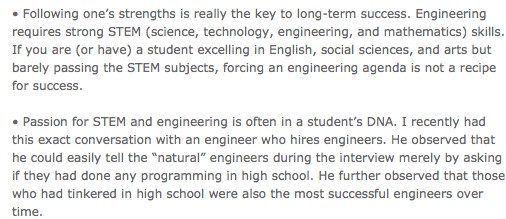
Characteristics of a Successful Engineering Student
Here are some key characteristics, according to Hollis, that teenagers should have if they want to aim for an engineering degree:
- They regularly solve household problems. If the dishwasher or air conditioner conks out, these kids will pull it apart and figure out what’s wrong.
- They are life-long tinkerers.
- They have developed apps for phones.
- They have started a little company or created a product.
- They have done computer programming.
- They have taken the highest level math their school offers for four years. Ideally they have taken AP Calculus BC.
- They have also taken four years of science, which ideally will include AP physics and an AP lab science.
My Favorite Engineer
I recognized my own father when reading the above list. When my dad was in eighth grade he rewired his family’s tiny house that previously had only possessed one electrical socket. Growing up, I remember my dad keeping an old, balky air conditioner alive for many years beyond its life span and frankly there was just nothing he couldn’t fix in our house. Thanks to the GI bill, he was able to attend engineering school at St. Louis University and later went on to graduate school in engineering. As an electrical engineer, my dad spent more than 40 years at Emerson Electric Co..
My dad never tried to push any of us to be an engineer. Neither myself nor any of my four siblings became engineers and only one of my parents’ 12 grandchildren graduated with an engineering degree. My father would have been very proud of his grandson Kevin, who earned an engineering degree from the University of Missouri in May and, yes, he did find a high-paying job. But boy did he earn it!
The No. 1 way to cut the cost of college is to become an educated consumer. You can learn how by attending my popular online course, The College Cost Lab. I’ll be relaunching the  course in June 2016 and if you’d like to be notified when I have more details, please click here!
I have taken six mechanical engineering courses at night. I take them one at a time. Some teachers have in class exams and some have take home. In class tests scare me to death, but the take home exams take longer. Straight A student at night. I took EE as a freshman and couldn’t handle the math. I changed to a math major and graduated without finding a job in the field. I work as a clerk. The list is a definite description of me. Toughest classes so far were statics and fluid mechanics. It puts ideas in my head. When I took fluid mechanics, the teacher would ask questions about how to solve the problem and few except me volunteered the answer. My math training didn’t help with work, but I could understand the solutions in the book. I got my hands on solutions manuals for some classes. I learn more from trying to understand the solutions than from the classes sometimes. I do as many problems as possible if I have a solutions manual. Night classes seem more easygoing than day classes, but there is still plenty of work involved.
Quite a good wrap-up of what an engineer is like. But even if you are made of the right “engineering material” you can facilitate your studies by following field-proven habits and working practices. It is not only the technical side that you need to master but also the “soft skills” of time management, knowledge organisation, efficient exam preparation, scientific writing, how to efficiently share your knowledge with others, mastering presentations to “advertise” your ideas. Staying in shape to sustain the heavy workloads etc. So what you really need to learn is to work efficiently to get very good results, and it is this working style that also helps you not only to get a good job but to be able to maintain a good performance without wearing yourself out. I’ve tried to compile these insights in my book “How to Become an A-Student in Science and Engineering” to help students to become more efficient.
You seem to have this idea that you must have been some tinkering or math prodigy in high school in order to even consider being an engineer, and I can say this is just not true. I grew up in a town with no robotics club, no ‘engineering’ courses other than a 1/4 of a year class putting together a robot from a kit, and no calculus II classes even in the nearby community colleges. I was a girl and only child, so even though I wanted to play with the old TVs or lawnmowers when they broke, my dad never let me, probably out of worry that I’d get hurt or break something. But you know what? Despite all that, I am a successful mechanical engineering student at a top college.
Please stop spreading the myth that you have to be born into engineering and opportunity to succeed, because that is all it is, a myth made up by people born into engineering and opportunity in order to feel superior to ‘fake’ engineers. Yes, engineering takes a lot of hard work, but as long as you are passionate about it and don’t give up, it doesn’t matter if you’re 15 or 50- you CAN become a successful engineer!
My brother did so poorly in high school he failed senior year and was forced to take summer classes to finish. I never saw him fixing, creating, or tinkering with a single thing while growing up. He is a mechanical engineer now with over twenty years experience. He is also the first person in my family to earn a bachelor’s degree, while our father was unable to finish his junior year of high school. He also completed his degree while working full time and raising two children. Don’t let anyone tell you that you can’t do something! Life is hard enough. Give it your very best shot. Sometimes you make it, sometimes you won’t, but if you don’t at least try, you have done yourself a great disservice! Best of luck to you all!
This article
you are only good at engineering if you have always been good at engineering.
You are born with it.
This is basically the message that I got from this article.
I looked at all your responses and I agree with every single one of you because you all said different things and they are ALL true. I am a very observant person. I wanted to be an astronomer in 6th and 7th grade. Also wanted to be a surgeon idk why. Then I moved to a different date in 8th grade and then I decided I wanted to do Mechanical engineering becaue before I moved I used to live with my uncle wand we made stuff with wood, screws, and metal. We put together anything we could find to fix something or whatever and I missed that stuff when I moved so I realized that I loved tools and how they work and how different t mechanisms work. I fall in the category of smart intelligent and genius but mostly intelligent and a little bit but not too little of genius. I speak 3 languages fluently. Read speak and write. Anyways that’s not really the point what I am trying to say is that in school I understand the concept very well but something’s get questions wrong on tests because I just do the problems (and I am very stubborn so for me it’s all about learning). I am a junior and I am taking AP physics and I have a grade average of B and in precalc I have an avegarfe of A. Grades show pure obedience not intellectual skills. Most of the times I doubt my self if I’ll make Mechanical engineering (Masters) becaue there are couple of kids who have far less experience around physics and they get better grades than me. So because of that I doubt my self. And they don’t even want to do anything Physics major related. Maybe a little bit but not too much. But sometimes I gain confidence becaue I am part of my schools robotics team from FIRST and I have learned many things but I haveing really done them a lot by myself becaue I like to lead and do it together not boss around. So at the end I don’t even know why I wrote this off topic essay. But these are exactly the thoughts in my mind right now. I would love to hear someone engineer or experienced
Engineering student tell me if I’ll make it but just be honest.
What I want to know is to major in engineering, is it necessary to know how to do certain stuff before you enter college or will they teach you how. Like programming and whatnot. Now Im not asking if you have a chance at making it in engineering if you dont know how, I’m asking if they teach you how to do it instead of expecting you to already know how.
If the student has the drive, she may succeed in getting an engineering degree. The first thing I would look at is her skill at taking tests, both in-laws and standardized. My math grades in high school and the college’s entrance exams were very low for engineering. What I now realize, after a very successful 30- year engineering career, is that 1) I am a poor test taker and 2) I am terrible at adding, subtracting, multiplying and dividing. What made the difference for me was that I was good at chemistry and physical sciences.
Engineering courses, especially the first two years which are very heavy in sciences and math, will be difficult. However, there is another option. Many schools have a degree program which combines engineering and business management. While she may have to take the initial year in the sciences, the science and math burden is lesser in later years.
I disagree with the notion that students who don’t “tinker” with stuff or get into programming in high school will not be successful in engineering. I didn’t really get into that stuff until later on in college, and I have a Ph.D. and 2 masters degrees in engineering (mechanical, chemical, and materials science and engineering). I am also a licensed professional engineer and I am an engineering consultant with a successful practice and have spent several years practicing engineering. I did take calculus courses in high school and actually wanted to get a Ph.D. in math until my parents talked me into engineering instead. I was passionate when it came to solving math problems (still am), but I figured out how to turn that passion and apply it towards something more practical that I could make money doing. I disagree that you can tell whether someone will be a successful engineer by whether they like to fix things or take things apart. My brother in-law was like that as a kid, he can fix or alter almost anything, but he couldn’t make it through an engineering program (couldn’t do the math or the theory). He is a very skilled technician though, and a very smart guy with a mechanical mind.
Not to turn into Mike Rowe, but I think telling people that what’s important is getting a degree and what it’s in is “less relevant” is the wrong message. I know too many people who go to college and take on a lot of debt and eventually end up with a degree, but no one will hire them (except for retail and restaurant jobs). My wife was in that position until she eventually made a connection in Human Resources and got into that, and she tells me constantly she thinks her college degree is worthless because she could have just tried to get into that after high school instead of going to college (and wouldn’t have the debt from it). I don’t think you need to go to college in order to be successful, because I know a lot of people who went into the trades and now they’re successful business owners. In fact, depending on what you go to college for, college can set you back in life. People will always need a good electrician, mechanic, etc. The market is saturated with people that have non STEM degrees, and my wife has told me horror stories about applicants who went to college, can’t find a decent paying job, and can’t pay their bills and their student loans. The volume of college degrees applicants for office jobs is unbelievable, and many of their applications don’t even get a view because there are dozens if not hundreds of applicants for a single job. This “everyone should go to college and get a bachelors degree” is a bad message because it’s screwing over an entire generation of people. Not everyone is meant for college, and it doesn’t mean they’re dumb or that they won’t be self-sufficient. Many are very intelligent people. We need to be guiding kids towards practical careers, tell them their passion is important, but be real with them about career prospects in certain areas and make them realize that your passion may not always pay the bills.
This ^
I don’t think people get that you can be successful without a degree, BUT you have to be DRIVEN to do well. Success isn’t going to come to you while your sitting on the couch eating Cheetos and hand you bags full of money every day. A lot of people, after high school, just don’t have direction and, therefore, lack motivation to work hard. Whether it’s working hard in college to become an Engineer/doctor/lawyer/accountant/programmer or working hard to “own” a career field and becoming “the” go-to-guy for that career field.
But back on topic, I think it also depends on motivation levels at certain times in life. For example, I was always decent at math but hated the sciences in high school. Now I am a little over 30 and can’t wait for each assignment in my physics classes. And soon, engineering classes. (Going to retire in the somewhat near future and want to be an EE for next job.)
Sir after reading your blog I came to realize that am not all that smart but I have passion for engineering, I love fixing stuffs and making some things although am not good at it but am very happy when ever I get it right.
So am asking do I stand a chance of being a good computer engineering student
As a physics graduate student who takes a lot of classes with engineering students and considered engineering as a degree..I disagree with this page.
Getting an engineering degree is nothing special, you take two years of math and physics and then move into designing courses, ethics and spend time in the laboratory. You BUILD a skillset in the classroom.
Thinking that you need to have some sort of resume coming into the degree to pass it, is at best, ridiculous.
Would it hurt coming into computer engineering program knowing how to build a computer? Ugh, no..duh! But is it needed? Absolutely not. Would it hurt coming into a civil engineering program after building a house? Nope! Not at all…zzz. Nor would it hurt being able to “rewire the entire house” in an electrical engineering program.
RELAX.
You really aren’t that special. Engineers seem to have this ego to them that they are the cream of the crop program..but why? Often the weeding courses in Engineering programs are the introductory physics and math courses. HMM? Thats cute.
Seriously though, the average engineering student will be 140lbs soaken wet, probably with acne on his face and white tube socks with white running shoes. Their life experiences aren’t that fabulous and they are just like everyone else. Okay, cool beans! This is the same thing with physics majors, we aren’t einsteins coming into university..we don’t necessarily have crazy math and physics scores nor are we necessarily “math people.” It is called WORK ETHIC. IF you come into a STEM program you are going to have to…..WORK.
tl;dr: An engineering degree requires a work ethic, not a resume.
Well, although you aren’t neasasarly wrong, you definitely aren’t right. The first two years in engineering are so packed with content that you are at class all day while the sunshines, and you need to study for about a half an hour for each of the six classes everyday just to get enough of a grasp that lectures make some sense. Oh and did I mention that nearly all the classes you take have a 3 hour lab? As for the comment about how engineering students are the stereotypical nerd, well most might like Marvel and DC, I’ve only seen a few who fit your visual discription. I personally am about 180lbs and 6ft tall. And come on, acne comes from puberty which is right before the standard teen goes into university. While I would agree with most which you have written, personal appearance has nothing to do with what you can do. See you need passion to make it in engineering, and a drive to succeed when everyone else is quitting. You need this more than anything else, and far more than any other course load.
I’m sorry for the length and the irritation, but for years students who take engineering have been persecuted for “assuming” their course is the hardest. Also engineers have been working to break the negative stereotypes and restrictions which describe an engineer.
I agree with physics dude 100%. In high school I didn’t know what I wanted to do. I was the oldest child and my parents never went to college. I just lived the high school life playing sports, hanging out with friends and doing just enough to get by in the classroom. I graduated with like a 2.3 gpa in high school because I didn’t care/know any better. However I am a senior mechanical engineering student now, who didn’t even know what a unit circle and trig functions were before entering college. But I’m doing fine. The main thing like physics dude said is your work ethic. In a STEM field the courses are no joke and you will have to study and work hard to push through it. You may be the person who likes to procrastinate and then study for an exam the night before the test or do the homework last minute…I was like that. However after your first test in a physics or calculus course you will quickly realize that won’t work. But if there is one thing that I believe will help you in the long run, no matter the STEM major you choose is getting really good at algebra. I always found myself going back and studying things I forgot how to do using algebra.
How did you even get into an engineering program with a 2.3gpa? You must’ve taken a different route since all schools my son is trying to get into expect at least a 3.25gpa and a 1290 newSAT score. Lmk so I can pass on the info to my son. Thanks
Not the same guy but it really depends. GPA doesn’t define everything. You can have a lot of extra curricular activities, maybe have some first hand experience somehow in high school. If your son has a lot of responsibilities outside of school then I don’t think most schools look past that. It also depends on the school, and how your son presents himself in his writing when applying for admission. From a sophomore electrical engineer at bradley^
I had a 2.5 and got really lucky. Did a lot of volunteering right before college though. My work ethinc was demonstrated, and is now demonstrated, as my gpa went drastically up, rather than down since joining college
I am in a different situation. I was not at all successful in high school, I was the kid that no one really knew because I wanted to just get through high school without being noticed. I didn’t take any AP classes, I did do a lot of tinkering, graphics, graphic design, worked with Autocad, I had an interest but was always shot down by my parents. My parents have no education and had no care for it either. I am the first of three kids to even graduate high school. I went to college and became a firefighter/paramedic but I have always wanted more out of life. I decided last year that I would go back to school and try some math classes physics chemistry stuff that I’ve never taken before and I’ve been extremely successful in getting A’s in all of my classes so far. I definitely have a curiosity that gets stronger by the day of Technology and Engineering in itself but I seem to be having a serious problem where I’ve never been exposed to engineering so I don’t exactly know which engineering to go into. Including my credit as a firefighter paramedic I’ve now taken Calculus 1 + 2, physics, and chemistry and I Gabe attained an AA in physics. My major right now is physics but I’m not too sure if I’m on the right track as engineering seems to get me more excited and I think I would enjoy it more. Any advice would be greatly appreciated.
The author does not claim to be an engineer; she does claim to be the offspring of an engineer.
She is describing the cliché engineering student. Cliché engineers end up with cliché engineering careers. Cliché engineers solve problems in cliché ways. Cliché engineers can be replaced by an algorithm.
There is plenty of room in the engineering field for anomalies who speak the engineering language but approach problems in an unique way.
Also, there is a great deal of writing in engineering and communication is probably the most underrated engineering core competency. Communication will your peers make your engineering studies easier, and communication will make you more successful in industry.
Study engineering. Try. Strive. If you fail out you can always become a teacher, or a barista, or an artist, or work retail sales.
-A mechanical engineer in industry, not the offspring of someone who was, at one time, an engineer.
I am in a tough situation that I can’t see myself out of. Throughout high school, I was focused more on math, science, and play soccer. I ended high school with a GPA of 4.0 but a SAT score of 1650. By the end of High School I had completed, AP US history, AP calc, AP Chemistry, Uconn Physics 1/2, and AP statistics (however I always scored 3s on the AP tests except for Chemistry). The only biology I ever took was freshmen year of high school, regular biology. Now I am about to start my sophomore year of college and I feel lost beyond belief. My first year I spent retake Calc, Biology,physics, chemistry just to get into the Biomedical major. At the same time, I was playing division one soccer and not really focusing heavily on class material. I since quite the Schools soccer team to focus on academics. Now I am declared as a Biomedical Engineering major even though I hated biology (scraped by with a low B-). Part of my problem is that I don’t feel like I have the personality to be an engineer in general, but I don’t feel drawn to anything else either. What would you guys suggest I do to find what interests me?
Jeremy, one question. When you think back to when you selected to go for an engineering degree, do you knowledge feel the same passion about engineering?
From what you have written, it appears that you burned yourself out in high school. No matter how advanced a high school science class or math class is, college science and math is the big league. Just attending lectures and doing assigned work just won’t do it. Textbook material is an integral part of the work.
I hung in for the first 2 years by my fingernails. I limped by with C’s, even after taking some AP classes. I made up for lost time when the class size thinned out and I was taking real engineering courses. I didn’t graduate with a stellar GPA, but I did get a good job out of college and had a highly successful career in engineering and engineering management.
Most people who leave the engineering curriculum, try business management. Large engineering project have business grads on the team in strategic planning, project budgeting and scheduling.
Best of luck!
This is the dumbest article I’ve read. I didn’t do well in math when I was in high school, and it had nothing to do with me not being capable. I never solved things around the house, and I never created apps or programmed anything because we didn’t have a computer. I had crappy teachers in high school that refused to help if you didn’t fully understand the first time and where I grew up, education wasn’t a priority. In no way does that mean that my high school transcript will tell you wether or not I’ll be a good engineer. I’m a mother of two and in my second year of engineering, I bust my ass and make better grades than those who “fixed things at home” or have a “high gpa” in their math and science classes. Engineering is pushing through no matter how difficult, it’s caring to understand and grasp as much as possible. A gpa doesn’t define you, some are hands on and learn better by doing. I hope a student never listens to your terrible advice, if a student wants to be an engineer, let *them* try it out and make that decision, even if they drop at least they know it’s not for them. The reason people struggle in stem majors, is in part because of people like you, that say either you get it or you don’t, and that just isn’t true. You privileged, snobby Jerk.
I wouldn’t say the “you either get it or you don’t” mentality is why people struggle, it’s why people don’t even TRY to attempt a STEM Major. This can be especially true at a large university where lower divison classes can contain up to 500 students taught by professors who are insulated from the engineering profession outside of the university.
I’m an engineer. I fit most of your requirements for a successful engineer. AP Calculus, AP Physics. High GPA. I liked to fix things around the house. However, doing well in school always came naturally to me and I never had to work hard. Engineering is tough. I think people that do a little worse in school and have to study harder to succeed have an edge over people like me for whom scholastics come easy. They already know how to work hard. If you want it, really want it (and not just for the pay and bragging rights), go for it.
Well,you mentiond abt d scores of pple,one can say being gggo in maths and othet core sciences qualifies one as an enginneering student.The essence of the maths itself is to help boost ur thinking,creative ability.You are kind of ryt bt i belive more on practicals than calculations coz calculations tells ur paper capacity while the practicals focuses on the real tin.All the same the both go in hand,just as the body cant survive with a soul so also can calculations not survive without practicals.I wish all the best to students aspireing to be enginneers.
Students who take AP Calculus BC are usually the most motivated students in their high school. Being motivated versus naturally smarter are completely unrelated. To simply say “because a student obtained 3.2 GPA in high school, they are unlikely succeed in a college engineering program” is ridiculous. I can’t speak on behalf of “pure” engineers, since my major is computational modeling/data analytics, however, I have taken pure engineering classes for my minor. During my years as a high school student, I was exact opposite as to what the author described the “ideal” engineering student was. I graduated with C+ average, and the highest math I took was pre-calculus with trigonometry. I wouldn’t dare tinker with the unknown. I might have been one of the worst students in my graduating class. The only reason I ended with a C+ average was because I was in a bunch of retard classes, where the teachers were inclined to pass the student, regardless whether they actually learned anything. Initially, the thought of going to college was a deterrent. It was only after long contemplation and being face to face with reality did I really decide on going to college. I went on to community college for a year, and earned straight A’s, taking their most rigorous stem classes. I got accepted into a reputable stem school and have been able to manage a 3.8 GPA. I was once a dipshit who was carried through high school. It’s astonishing how much a game changer motivation is.
This is an interesting article which brings up some good points. I have been a mechanical engineer for almost 12 years, working in the oil and gas and petrochemical industries. I was one of the “very smart” kids in high school that made straight As. My English scores would be around 99-100 but Science and Math courses ran more to mid-range 90s. In general, I enjoyed reading and writing much better than math and science, but because I was still making very good grades in the STEM classes, I was encouraged to pursue that career path, especially as a female. My dad was also a big encourager on that front. I had always wanted to be a teacher like my mom, but I think that I pursued engineering because I wanted to make my dad proud and prove to myself that I could do it. I did really well in college until I took the engineering and upper level math classes. I really had to fight to get through the degree program, sometimes repeating courses that I failed the first time, and it took me 6 years instead of 4. By the time I graduated, I was worn out and literally anemic from all the late nights studying and poor diet. Through my career, I have learned that I am not a “natural engineer” like many others that I work with. Yes, I can figure out how to assemble and fix things to some degree. Yes, I am very detailed and organized and can do my job at an acceptable level and I have great diplomatic skills working between vendors and clients, but I’m not passionate about the subject matter. The problem is that once you are in the industry, it is hard to leave because of the money. It is a bit like a trap. And now that I’m a mom, I find that the schedule of a teacher would have meshed so much better with my daughter’s schedule than the corporate one I have. That is something that I really didn’t think about at the time I chose this field. I just wished I had thought more about what I really wanted to do than trying to please everyone else.
I would say make the switch. It’s hard to do it financially, but not impossible. Im assuming that you still have 30 ish years left in your career. Do you really want to do something you don’t love for another 30 years?
I’m great at Physics and Math. I have never gotten less than an A in either subject (with the exception of a B+ in ODE’s). Most of the engineering students in my classes couldn’t say the same. This being said, I am at the lower middle of the class in any of the other engineerjng classes. Mostly because I don’t enjoy it. While I think you can say some engineers have similar characteristics, it would be a terrible mistakes to judge who would be good based on arbitrary test scores. Most of my friends who are successful engineers (including my grandfather) say that most of these classes are a right of passage. In any discipline you will have a program do the calculations for you (mostly).
Don’t pick engineering because you’re good at math, or you will be miserable like me. And don’t let any counsilor talk you into it either. Shadow a few engineers, if you see what they do and still want it, go for it. Go to every class, be early, sit in the front row… The rest will take care of itself. Don’t let anyone tell you what you can’t do. 🙂
I have so many questions! I am naturally good with mathematics and can do well in science and plan to pursue a career as a computer hardware engineer. The potential problem is that I haven’t been exposed too much to computer things. I’m a fast learner and I just thought I’d be fine in pursuing this major because I am a good communicator and determined to be good in anything. Can I get an opinion if I should still pursue this? I mean, my hobbies don’t including fixing things, but I do like learning how things work and that is why I chose this.
Terrible article.
Getting good grades and standardized test scores does not mean a person won’t be good in a STEM field. They do NOT represent the real world.
I just don’t have the patience to explain why you are wrong.
Thanks for clearing this up, Im a highschool junior and this article literally just broke my heart. From I was younger all I’ve wanted to do was become a biomedical engineer. I have a 3.7 GPA which is mostly because of my great grades in English and Science, math… not so much. I wasn’t born with a love for STEM, I was born with a love for reading actually. Does that really mean my parents are going to watch me completely screw up college next year. This article is ridiculous. Shame, shame.
Give it a shot.
There are certain people who are natural engineers. This article lists the qualities that natural engineers tend to possess. There are people with natural talent in every field. People who have these qualities tend to make excellent engineers, but I don’t think the converse is true, that in order to make an excellent engineer that you have to be naturally gifted with those qualities. People can learn things and gain experience, just with a shallower learning curve. Also, some people may be natural engineers and not know it, never having had the right environment to explore their talents. I’m in my second semester of mechanical engineering. I took all my applied science courses in cegep and finished with a 27.5 r-score which is pretty average. The university was accepting a 24 r-score. They expect a quick learner but not a genius. The best way to succeed seems to have more to do with study strategy than natural ability.
This article is ridiculous lol. I barely passed high school. I came back to school at the age of 22 and I’m about to graduate with a 3.5 GPA at the age of 26. Guess what my major is.. MECHANICAL ENGINEERING.
Oh yeah Anthony. I’m right there with you. like failed classes in high school didn’t go, didn’t care at all, never took my sat or act or anything. I wasn’t at all a great student. But I knew that I wanted to do something cool, something that would help people. I’ve kinda always been a good thinker.
But this article doesn’t mention about THE EFFORT. EFFORT is very important.
Hello!
My name is Humza and i’m a junior in high school. I really have a passion about being an engineering and engineering a better future for everyone! Im taking engineering as of right now (We just got an engineering course and a cyber security course). Im fond of science but math I’m not the best in average, i’m in Algebra 2. I like math if I understand it but the teachers here don’t like my questions! They usually get annoyed or just tell me to do examples in the book. I don’t want to mess up because i cant understand the first couple times. So is there anyway any of you nice people can help me and give me some help, like as where to go to get math help, websites, programs, etc. Thank you!!! 🙂
Hi Humza,
I would highly suggest that you use this resource – the Kahn Academy. You can learn any kind of mathematics through the Kahn Academy and it’s all free. You can also study for the SAT for free for the Kahn Academy.
Lynn O’Shaughnessy
Humza, I am graduating next semester with a Mechanical Engineering degree. I struggled like it sounds like you are saying. http://www.youtube.come worked great for me. I liked the patrickjmt channel the best. You may not find the exact problem that you are looking for, but if you do the problems along with them it will help you grasp the steps/ideas of the problems.
I also used http://www.wolframalpha.com when I was in differential equasions. Chegg.com is another site that I have seen many students use for help with their homework. These last two sites are not free like youtube or Kahn Academy, but in my opinion they were well worth the price when you don’t have to pay for another college class.
Good Luck, and remember that when you finally get past all the really hard math classes it gets a lot of fun! I am building a robot in one class, and in another class I am designing a manufacturing line to produce agricultural tools in struggling third world countries. You have to get past the math classes then it really pays off!
He,y i am 16 and a junior in high school. I didn’t always know i was passionate about becoming an engineer until i starting taking ap physics and learning how to program on my own. Outside of school i probably put in 4 hours a day into learning mechanical engineering and reading books on how to build robots. My dad is an engineer but never pushed it on me i simply discovered that i want to be an engineer on my own. I don’t know yet how to fix things and rewire houses but im putting in consistent work and time into learning. I was wondering if the fact that im working so hard to be an engineer now will make it possible for me to survive ad an engineer. I have already told myself that i am willing to put any amount of work into this and have a huge list of books and text books on mechanical electrical and robotic engineering i am going to and have read. My question is, is it enough in your opinion? If you respond can you email me — mikentango@gmail.com
This is very inaccurate and not true. I graduated high school with a B- average and a 30 on the ACT. The ACT score was high but not the B- average. I majored in Mechanical Engineering and have a 3.7 GPA taking my majors classes. Just because your kid does not make good grades in high school does not mean he will do bad in college as well. I did not do well in high school because i did not care and the highest math I took was Pre Cal. I came to college knowing the importance of a good GPA so i put in the work and have made an A+ in Calculus 1,2,3 and differential equations. I know plenty of kids who come into engineering who made good high school grades who fail out because they assumed college would be just like high school when in reality it is way different. More learning is done on your own then taught in class, so if a kid has been used to learning everything from the teacher and expect the same in college they will not do well.
“if a kid has been used to learning everything from the teacher and expect the same in college they will not do well”
Absolutely True. I made it past Calculus I, but barely passed Calculus II and had to drop out of Physics I in my second year of college because of this mentality. Homework is mostly not collected and/or assigned in college, but technically you do have homework every night. This means doing practice problems from the book, retaking notes by watching YouTube videos or reading the textbook and deriving formulas from there. This cannot be more true for Engineering, where concepts build on top of one another and you’re screwed if you don’t know the fundamentals.
I actually like learning myself, because I cannot, for the love of god, pay attention in class.
“She has a GPA of about 3.2. While it’s not impossible that this child could survive an engineering program with their notorious drop-out rates, the odds aren’t good.” What evidence do you base that claim off of? And what qualifications do you have to make such a statement? “My dad never tried to push any of us to be an engineer.” Because he knew that you either didn’t want it or perhaps he figured that you couldn’t do it.
High school GPA is somewhat irrelevant to one’s success in earning an engineering degree. Trust me, I hardly made it through high school and now I’m halfway done with my aerospace degree. Now what? You want it? Go get it.
My god thank you so much ! I am in Ap Physics C right now in my senior year but my highest math is pre cal. We are starting to go over Calculus based subjects in physics and I have been reaching my self the basics of calculus outside of school . I also plan to attend college for an aerospace engineer and reading that you and other people have made it with the same conditions I am in really does give me hope.
Thnx for d post lynn, even though i disagree wit u here, all d comments tht were against u really encouraged me more than ever to major mechanical engineering ^^
Me too! The article almost crushed me but these comments brought me back to life quickly.
Hello my name is Jordan Gibson and I am a Freshman in High school in El Paso. I recently talked to my father who was an Engineer for the Air force and he talked to me about the importance in excelling in STEM, which is the current program I am in, and in excelling in problem solving. I often contemplate what it truly takes to get into college to major with an Engineering degree. So, my question is what does it truly take to get into college with a major in Engineering and where do I go and what are my possibilities from there? Please email me back at Jordopherjr@aol.com. Thank you and I hope I hear from you soon.
This is an appallingly stupid article. Yes, outliers exist. No, they are not the only people capable of successfully pursuing engineering. The author should attempt to think seriously before writing, and especially before publishing, an article. This is just lazy, cliched thinking.
The types of kids she describes above are few and far between. There wouldn’t be many engineers in the world if only those that were “lifelong tinkerers” and “regularly solve household problems” sought engineering degrees. That just isn’t the common teenager. And “starting a company” sounds more like a business major. I don’t many engineers that have started companies. Unless you’re seeking a degree in computer engineering, you will only take an intro class on programming. I can hear the Admissions Counselor now, “You’ve never started a company or invented a product or even tinkered before? Denied!!” If engineering schools adhered to Ms. O’Shaughnessy’s theory that “you had to have done it before and at a high level in order to have any success” would have eliminated most, if not all, of the engineering students I knew in college.
I was a C- student in high school. I graduated with a 1.83 GPA. Average by anyone’s standards (technically I was below average but who’s counting – besides Ms. O’Shaughnessy). I never took AP Calculus (or any calculus) in high school. However, I graduated form college with a 2.90 undergraduate GPA and 3.5 graduate GPA…all in engineering physics. Had it been up to Ms. O’Shaughnessy, I would have never been accepted to my particular school of engineering. Oh yeah, Ms. O’Shaughnessy, I will present my doctorate thesis in a few months.
In my opinion, a “key characteristic” that I think lends itself to being good at engineering is passion, but can’t “having passion” be key to being good at anything? And “mastering” high level math and science is different from getting an A. I would think a college consultant would know that….she is a college consultant isn’t she?
My advice to the potential student she mentions. “A student with a 3.2 GPA stands a better chance than most of succeeding at engineering…study and retake the SAT although most schools take a holistic approach at admissions and place the proper weight on test scores. If engineering is what you want and you’re willing to work for it, I’m here to help you achieve it.” Ms. O’Shaughnessy’s attitude is EVERYTHING that is wrong with education in general but higher level education for sure.
This article is boarding on elitist. I mean it’s dishearting to see such archaic beliefs can still permeate people’s minds. When I was 12, I had a brain tumor, and after years of fighting with surgeries and radiation I finally over came it. I was than tested to see if any permanant damage had befallen me. My iQ was tested and it was until years later, after scraping past highschool, and barely getting out of grade school did my mom tell me I scored a 90. This aggravated me. Who was anyone to tell me where my intelligence lied on par with my peers after what I had been through?! Did those other high IQ children have alcoholic father? Did they feel a sense of responsibility to forgo school in exchange to help pay bills? Did they have to suffer through multiple brain tumors while attempting to learn? It was then when I realized something as superfolous as an IQ test or an SAT, means absolutely nothing. It’s equilvency is that of taking a strength test in highschool and determining “this is all you’re ever gonna be able to lift.” Nobodies life is similar, not ever child is healthy, not every child is given an environment to learn, not every student is afforded the privledge to be curious. All households are different. I set out to prove people like you wrong, that I don’t have to born with STEM skills, that I need to be predisposed as a youth, that my intelligence is set in stone. I work out my brain like I work out my body, but instead of the gym, I get my reps at the library. I’m one year away from a degree in Biomedical Enginnering. If you claim to be someone of intelligence than don’t ever assume it’s for select few, because it’s not.
I totally agree with you, this article is ridicolous. The first level calculus series as well as intro physics or chem series are such a minute part of getting an engineering degree. Students who take AP math/physics maybe 1-2 quarters ahead of an average student starting with calculus 1 but guess what, engineering courses are what actually matters.
I’m so sick of elitist engineers who think that they are better than everyone else. It discourages students who might not have access to AP courses or guidance from college educated parents.
I’m the daughter of two immigrants, I was almost pushed out of high school for being diagnosed with epilepsy, and I didn’t do any of the listed above recommended “characteristics” of engineers. But guess what, I’m graduating this year with my engineering degree with 3 job offers, 2 publications, 4 years of internship experience(yes starting from freshman year), and no debt thanks to scholarships and income from internships.
This shit sounds like it was written from the preservative of some of the privileged ass, spoiled, douche-bags who’s daddy pays for school. If any kids are actually reading this, dont take this advice. If you want to be an engineer, contact local universities or community colleges to see if there are any summer programs or professors in the filed that you are interested that will talk to you about what it takes. The internet is full of bullshit opinions, go straight to the people of have the experience, it will also help set you up with a network that can help lead to internships.
I agree with the premise that you shouldn’t do something you don’t enjoy or would like to pursue. Anything done against one’s will is a recipe for bad performance or downright failure…
What I disagree with is the belief that it’s in your DNA. That some people are naturally better at social sciences or natural sciences. You underestimate the human condition, DNA does play a role… But a good environment and a strong will play an even larger role. Hard work beats talent any day (if the work is done efficiently of course). If a student really wants to be an engineer and struggles with math and science, if they want it that bad…. They will figure it out.
I work in the oilfield as an offshore mechanic and my company is reimbursing me towards a mechanical engineering degree. I am half way through Integral Calculus so I still have several years left.
As you can imagine, engineers play a very important role in the oilfield. Important as in the financial guys. They are good organizers and put together some awesome power points.
I know this is not true for all engineers, but 95% of the summer interns they send us have never touched a wrench and certainly do not want to get greasy by pulling things apart.
The engineers like the writer’s dad are rare and that is why he was so valuable to Emmerson. The engineers coming out today are obviously brilliant at STEM, but not at the hands on. Our seasoned mechanics and electricians meet all of your attributes out here except the strong math skills. They can’t do calculus, but they can add and subtract just as good me and you and can also get a turbine engine running when your average engineer would be dumbfounded just staring at it.
In summary, all you need is a good STEM background to be an engineer. The company will teach you everything else they want you to know. I’ll leave you with a quote that a man I work for said in reference to an engineer trying to solve a simple problem with complicated math: “he kept saying wait, I can work this problem like this. And that went on and on as he tried to revert back to his college math and then got the problem wrong in end. And so it turns out that he is just as dumb as me”.
Thanks for encouragement,I work in a laboratory for more than 6 years now.
My real problem is l cant go and study engineering at any universities because l failed Mathematics.Is there anywhere and anyway l can do to study engineering without them looking at my mathematics background.
Thanks for your help in advance.
Ashnay.
I find your article both correct and wrong at the same time. Here’s a little lesson for you: engineering is not about how smart you are coming in. It’s about how much time you’re willing to put into studying.
I’m a mechanical engineer, and I was a very very good student in college. I scored a 32 on my ACT (never took the SAT for some reason) and had a 4.0 (they dropped weighted GPA) while sleeping through most of my classes.
What happened when I went to engineering school? My first semester I passed everything, but with all Cs except a single B. I skipped class and didn’t study much. I finally got my act together and did well.
My closest friend in college had taken 5 years to graduate high school. He barely did graduate the 5th year. He went to the marines and served 8 years. Then he came back to school, but this time with a purpose. He started with algebra, and it took him an extra year and two summers full of classes, BUT he graduated with his engineering degree, a 3.3 GPA, and got an excellent job for an aerospace company, which he still has. His secret? He studied his ass off and did really well for himself. But he had the drive to.
I think, looking back, none of the classes were that hard. Even thermo, fluid dynamics, and all the ones I was warned about. If you work on each class a bit each day, allotting time for EACH of the classes you have, and shifting focus on the ones you need more time on, you’ll be fine.
I am a high school dropout from the age of 19. I have had my fair share of bumps and bruises along the way. In 3rd grade math was fun because my grandma had me studying. I learned my multiplication table and raced my classmates on small math tasks. High school and life in general became very challenging for me. I had a lot of healing to do. I’ve worked as a salesman for a year and in a sausage factory for another. It’s been mostly fast-food apart from that. One day I decided I needed change. I made a plan then and I am sticking to it now because I am hopeful for a happy ending. I decided to go to cc to begin a degree program in engineering because I have come to notice the importance of problem solving skills in all aspects of life, and I wanted to challenge myself. I must admit engineering is an acquired taste and it isn’t for everyone. You have to want it. Hard work beats an IQ everytime. If not in test scores then in everyday life.
In my opinion engineering is the only degree program worthwhile for me because of my desire to make a positive contribution to society and because of the debt that I am taking on. It just makes sense to me. It’s common sense. The world needs more engineers and it’s just the most sensible and practical choice unless you have huge talents elsewhere. Engineering is for your everyday person. Believe me I’m not special. I just realize my own opportunity to get myself out of debt, help my family, and if everything goes right, help the world.
I have an average IQ, and an overactive imagination especially when anxiety takes it’s toll. I also have a few friends that have been a little more privileged as they have parents that are engineers but I am doing better than some of them because of my maturity. I like to consider myself a genius, not because I’m intelligent but because I choose to be. I’m more of a philosopher than anything else. I am very stimulated by learning. My overall goal is a career in politics. In order for me to secure my future I am beginning to lean towards petroleum engineering. I am not an advocate for relying on carbon based fuels by any means. I think we need a shift in power and that businesses interests are being looked after directly more so than the people’s are. Perhaps it is for good reason and even justifiable, but I can’t help but think there must be a better way.
Yeah I’m doing petroleum for money but that’s not what motivates me, its the opportunities the money will create for myself and for others. I would love to make a scientific breakthrough by developing a technological advancement that will revolutionize the way the world is and enhance everyone’s quality of life but I’m not sure that will happen. After a few years as a petroleum engineer I hope to begin a dual grad program in business and law. It’s those three majors combined that I believe will build the skills that will make me better equipped to take on the challenges of the world. For me to accomplish my goals I need the money.
I have always taken the time to participate in school clubs and liberal arts courses because that is where the real learning takes place. It’s a shame that education is heading in the direction of developing processors for corporations and getting students to buy in instead of making it’s students better people. Money can’t be the ends of a mean but only a side effect of creating an all around value. I hope that my perspective will have an impact on any organization I ever become involved with. I love nature and want to limit any harm done to it. I gotta do what I gotta do to survive in this world and to help other people.
At this point in my academic adventure, I have slightly under a 3.1. At the age of 26 school is pretty new to me and my GPA would be better if it weren’t for a few unfortunate chain of events. I too began college taking intermediate algebra. Now I am taking calc 3. My first test score was a forty but no worries the lowest score gets dropped. My second exam was an 88. Just this past Friday was my third exam and I expect it to be even higher. Every semester I feel like dropping out but I always succeed. I just have a flame plain and simple.
In today’s world it’s sink or swim. No matter where you come from you must simply maximize the opportunities you have in life and everyone’s are different. If engineering is something that just makes sense for you to pursue then just go for it. I’m no longer putting it on a pedestal that’s just out of my reach like I have done with so many other things in my past. Lets break the mold and become what we want to be. Engineers are the future of our existence. I’d make the investment again and again. Liberal arts are easy and fun but that’s not something to commit to if you catch my drift. Those sort of things can be learned if one keeps an observant perspective throughout their daily routines and independent research. I just don’t think it’s smart to become a soft science major unless you want to become a proffessor or are already well off and can afford to do that.
In summation, the name of the game is survival and not harming others. It’s all about finding the utilitarian thing to do. No matter what you choose to do in life make a plan and keep on learning and adapting. Don’t consider this article to be a determining factor in deciding your future. The journalist did a good job, but he is a journalist and it’s his job to get people to read this and nothing else. I have good faith that the writer is coming from a good place and is doing a good job of helping people to not set themselves up for failure. The problem is he could be setting people up for failure by having them choosing a major that will chew them up and spit them out into a saturated job market with no useful skills backed into a wall being forced to take whatever job comes their way and taking on debt that will never be paid off.The only key ingredients needed to succeed are believing in yourself and doing the wor. Where there’s a will there is a way. You don’t have to be book smart because there are ways around that. I have a learning disability but somehow I have developed a decent amount of social intelligence. That has opened plenty of doors for me.There’s more than one way to skin a cat.
This article is right on. Engineering is a field where the passion comes early and stays through high school into college. Those kids engaged in STEM show interest early on in these subjects and they excel.
That should not be surprising. Musicians, writers, dancers all show early passion for their discipline. It’s silly to think STEM would be any different.
There is, as the article pointed out, a tendency to emphasize that kids “must study” majors “where the jobs are.” Right now, those jobs appear to be in some types of engineering and computer science. This mistaken view by the pundits and some parents is that college students merely have to “shop around” and pick the majors that are “vocationally hot.” But that’s silly. Anyone who knows some psychology, especially personnel psychology, knows talents, motivation and abilities don’t allow students to “shop around” willy nilly for a major–as if ability and motivation do not matter. They do–a lot.
Not motivated by STEM? Stay away from it.
George DeMarse
LRS
U.S. Office of Personnel Management (Ret.)
Note practically everyone who disagrees with me is “already” an engineer who got good grades in math througout high school. I rest my case.
George DeMarse
George, I somewhat disagree with your premise. It is true that people who excel in their respected majors have already developed an interest and/or passion before college, and since Engineers have to take more units than practically any other major, they don’t have time to explore other fields. However, peoples interests don’t remain constant over time, and innate ability isn’t respective of anyone. One person that may have wanted to become an engineer and tinkered with basic electronic kits as a kid suddenly decides he wants to own a hotel later on in life and then major in Hospitality/Hotel Management. With that same logic, there may be someone may discover later on they want to major in Mechanical Engineering because they want to understand how things work. Also, someone who was bad at math in high school later on in life may suddenly go back to college to ace Algebra all the way to Calculus/Differential Equations and become an engineer.
In short, I don’t agree with what you’re saying. I believe that anyone, regardless of ‘innate ability’ has stones required to earn an engineering degree provided that he or she is willing to persevere. It startles me (or rather, doesn’t) how many people scored in the 99 percentile of the SAT, who majored in engineering, eventually washed out of their programs. On the other hand, the people that struggle to perform as well academically, well, you guessed it- earn their degrees. Technical degrees are not a measure of how smart you are. Here, the genetic lottery doesn’t count for much; I believe one can go so far as to say intelligence plays absolutely no role in college engineering – rather, it’s perseverance and willingness to adapt to the rigors that determine whether you succeed.
Most engineers’ heads seem to swell up after getting their degree… After all once you’re on the throne, it’s easy to overlook the trials you endured to get there.
I couldn’t agree more with your comment, which evidently pertains to myself perfectly. In my high school years I failed precalculus due to a complete lack of motivation and stopped working with math from there until college. I worked my way from graduating high school with a 1.8 gpa as well as low math scores on the act to reapplying myself in community college and finding my passion in engineering. I am now currently a junior at a good university in Industrial engineering making a 3.2+ gpa. High school is a test of motivation in academia, college is the test of passion and desire in the subjects you enjoy.
My social life suffers, my life is unbelievably busy and I am stressed 75% of the time, but doing something that is a personal success for oneself is what drives an engineer through the rigor of the program they are enrolled in.
Thank you Andrew for your great comment and hopefully my journey will help push those who aren’t as successful in high school as some say is mandatory.
I’m actually in school right now for mechanical engineering at 32. I’ve never had to repeat a class and have made it through all of the nasty math classes unscathed. First and foremost high school GPA, SAT blah blah blah means nothing. Many of the “smart kids” end up switching majors to civil or business. Most of my classes at my community college started full and finished with less than half the class. Many of those guys ended up back at community college because they flunked out of university. (NOTE TO PARENTS, SEND YOUR KIDS TO COMMUNITY COLLEGE FIRST) It isn’t uncommon to have a low GPA for the first 2 years and then get better in your major so take your heavy classes at CC to save your GPA.
In my engineering college a little over 60% remain at the end but it gets better in Junior year. The people that spend their time whining are the first ones to go and then you have those who care so much about grades that getting a C freaks them out. There will be many C’s and some failed tests. On some tests nobody will get above a 65 but everything is curved so treat others as your competition. Most colleges evaluate that way.
Engineering classes take more determination than brains. There are times in the beginning you feel like you don’t belong or that others are doing better than you. When you have made it to your second year past Calc 2 and Physics 2 you do belong because it doesn’t get much more brutal than those two. Calc 3 is pretty brutal because it involves three dimensions partial derivatives, double/triple/etc integration. The next “hard” classes are thermodynamics and some say fluids. (KEEP YOUR GPA ABOVE 3.0 IF YOU CAN!)
The worst thing you could possibly ever do to yourself is lie. If you know you aren’t capable of studying or self motivation you will fail. If you can t work in groups, you will fail. If you can’t make new friends from diverse groups of people, you will miss opportunities. If a social life outside of school is extremely important to you, you will fail. If a healthy relationship is something you hope to keep, you will suffer. Wait until you two are stronger together or don’t get involved in anything serious.
Finally, most people become miserable due to the math and the science. I know its been covered but some of you will underestimate the toll the workload will take on you lives and cave. The first 2 years, which isn’t even two years, sucks. What sucks even more is living in your moms basement, working at McDonalds and/or not doing something in your life that has meaning. Get the past the first two years and its a plateau for a semester and then downhill.
I am a Chemical Engineer, and a Chemist, I have BS in both. I have been an engineer in the Chemical industry for > 30 years. That list of characteristics is stereotypical and while I know a few engineers that are described by that list, most are not.
Does your child excel at math?
If your child loves multi-step math problems in higher level math classes in high school he will ok.
Can your child visualize how things work? Can he describe them? I got a model of a V8 engine at the age of 8 for a Christmas present. For one reason or another my dad never got around to sitting down and helping me get started. I still remember looking at the detailed diagram on the back of the package and visualizing how the engine worked, I could describe every piece’s function.
I can tell you from personal experience that engineering is not for everyone, it’s hard and you have to be pretty smart to do it.
My own son is trying to be a petroleum engineer at a major university in Texas and is probably not going to make it. That’s why I am up at 5 am reading blogs on the internet.
I have come to learn several difficult and expensive lessons.
Not all things are about effort. When my son was struggling early with calculus and chemistry, I believed it was study habits and effort. Now that he is in the upper level classes and really trying and still not succeeding it’s painfully clear that he’s just not smart enough to do it. He gets As in all his electives and some of the easier engineering courses, but the “weed out courses” get him every time. He really wants to be an engineer, in the field, building stuff, making things happen. He started as a a civil, but did not want to take years of concrete classes. He got his grades up, transferred into petroleum and was passionate about his petroleum classes. Sadly it’s becoming evident that he just can’t do it. So I am not sure what happens next. He’s four years into college and still a year or two away from a degree. I have three in college and the money for him is almost gone. He’s always been a pleaser, which is why he went down this road.
I will add one more thing. I went to very small schools. Not these large factories. I believe the smaller schools genuinely care more about your child and want to educate as opposed to weed out.
This article is stupid! Engineering is HARD, but not impossible. You just have to want it and be willing to work at it.
This slightly worries me. I’m a first year mechanical engineering student and I’m super passionate about learning how things work and I excelled in math and physics in high school.
BUT I’ve never programmed until I had a mandatory class and sometimes electronics confuse me. I wouldn’t know where to start building a robot and and don’t feel like entrepreneuring a small business.
Knowing the drop out and failure rates of engineering majors this freaks me out because I don’t want to drop out or fail!
Oh, the whole “you have to be intelligent to become an engineering” argument. Sure, you could be the smartest one in the room, but in my opinion, that doesn’t mean you’ll succeed as an engineer. To me, what this career comes down to is how you manage yourself rather than how good, or in some cases “gifted” you are with a certain skill. It doesn’t require a high level of IQ to become one, but it does require determination. That’s all.
Funny article. Being an mechanical engineering student, I see all walks of life with varying skills in math and physics and intelligence; as long as there is a solid understanding in the basics of these areas mixed with solid study habits and descent reading skills and a high tolerance to prolonged stress and sleep deprivation- that’s really all is needed to complete an undergraduate degree in any engineering field.
I’m currently a Mathematics major with all A’s in my major classes, soon to be transferring into Computer Engineering. It’s always funny to me when people make the claim that Math and Science is somehow too difficult to comprehend for the majority. It’s not, and this is one of the most primitive and prevalent myths in existence. In fact this advice is one of the reasons for the lack of inspiration among youth in STEM fields. I hope in the future as more people develop a basic understanding of how our brain works, myths like this will be mocked. I admit that the best engineers most certainly had to have been very curious about how things work with a deep desire to understand inner elements of a system or structure. However, this hollywood promotion of obsession is not what’s required to do well at all. In fact, I think time and perseverance is more of a factor than anything else, that including patience, passion, and resilience.
@Lemuel..I absolutely love your comment. I will graduate with my MBA this December.I have worked full time throughout my undergraduate and graduate career while taking a full time course load. I am also an attentive single parent. I worked overnight law enforcement for over 5 years. Often times I would work more than 60 hours a week. My undergraduate gpa is a 3.1 and my graduate gpa is a 3.2. I made the decision to attend engineering school in the Spring of 2014…but I’m resigning to focus on school.
This article can be viewed as taking a realistic approach but it is also very narrow minded. The author is making the assumption that every student is supplied with the element to afford them with the ability to produce a higher gpa. Every situation and circumstance is different.
Correct: Mathematics is taught incorrectly at school and that’s why so many hate it and don’t major in it. Math in schools is memorization heavy, taught way too quickly without time to absorb concepts, and is taught in a high-stakes environment where you are penalized for getting a bad grade, whereas in reality, getting answers wrong in Math and checking your logic is the proper way to learn. And you’re right about the narrow minded approach to learning: someone in an affluent neighborhood is afforded ability to develop problem solving skills with math boot camps, robotics clubs, and connections in industry from parents.
This has to be the dumbest article ever.
But will STEM be a good provider?
Keep in mind that this blog post is not the gospel. It’s only an opinion of the author, who is not an engineer. I, however, am a junior in mechanical engineering at a well known university, I have interned at an international company, and am doing well in school. So here’s my thoughts on this blog’s list:
“They regularly solve household problems. If the dishwasher or air conditioner conks out, these kids will pull it apart and figure out what’s wrong. ”
“They are life-long tinkerers.”
-For these first two comments, not necessarily. There’s a difference between a tinkerer and an engineer. Sometimes these go hand in hand, but not always. For example, I have some good friends who like to fix their car, computer, household items, etc. These same friends went to engineering school with me, and dropped out their freshman year. Why, you may ask? After all, isn’t a “tinkerer” what an engineer is? The answer is NO. An engineer has an analytical mind, but they must also have a strong work ethic and be motivated to learn many things that are hard to understand. These friends of mine knew how to be the “handyman”, but they thought doing math problems and solving engineering issues on paper/computer was stupid, or they just couldn’t bring themselves to learn the material. My question to you is this. How is a car designed? Do you have guys with screwdrivers tinkering aimlessly at each car until its finished, and then driven out of the factory? No..you have many people designing each part and process until the car is fit to be produced (by using computers and engineering concepts), then you tell the workers how it should be built.
“They have started a little company or created a product.” How many teenagers do you know that have the resources / bright idea to patent a design or start a company? This comment is purely absurd. Of course, if your child has created something innovative, I’m sure their future line of work will be obvious to you regardless of what “most engineers” do.
“They have done computer programming.”
Not necessarily, unless your son/daughter aims to be a computer software engineer. To most engineers (especially mechanical), programming is just another tool we use, just as a construction worker feels about his hammer. I certainly don’t love programming, but it makes my work easier)
“They have taken the highest level math their school offers for four years. Ideally they have taken AP Calculus BC.”
“They have also taken four years of science, which ideally will include AP physics and an AP lab science.”
These two comments, just no…You can start from nothing and still be a successful engineer. I didn’t know any math when I got out of high school (didn’t plan on becoming an engineer until my senior year so I didn’t even remember my algebra). So what did I do? I went to my local community college and got placed in college algebra the summer after high school. I then went to Trigonometry, Calc 1, Calc 2, Calc 3, Differential equations, then on to my engineering courses after transferring. And you know what? Some people who take Calculus 1 will fail it because they didn’t know their basic maths as good as they thought (good old public education system), and have to retake the class. Thanks to me having my algebra and trig fresh in my mind, I got all A’s in my calc. classes, while showing some of the other students up.
My point is this: Do not let “myths” about engineering keep you, your son, or your daughter from majoring in it. There is not a prerequisite for the major. You only need to have a keen mind, a strong will to learn, and enough motivation to get you through the toughest major ever. Everything else will come along with your job/experience in the field.
Thanks Travis! I appreciate hearing comments who actually attended engineering school and survived! Congratulations.
Lynn O’Shaughnessy
Anyone can be an engineer if they want it bad enough. All it takes is putting in the work to get there. At one of the top 5 engineering universities in the world, I promise you most of us did not come in with Calc BC, most of us have never programmed on a computer before, most of us have not pulled apart our air conditioning systems at home, and most of us have never started a business. While I admit that most of us did come in with more than a 3.2 GPA, it does not mean you are not capable of engineering if you didn’t have the best study skills when you were 15 years old. Some people know how to study in high school, some learn when they get to college and are forced into those situations. The SAT and ACT mean nothing except for how fast you can take an exam. Engineering does not require anything except a desire to be an engineer. The problem with many engineers is they fall in love with the science. That will lead to amazing, useless advancements. It is much more important to want to make things happen in the world, not in your computer or lab. I don’t mean to be argumentative Lynn, but it would kill me if someone was discouraged from pursuing their dream of engineering due, in part, to this article.
Thanks for your comment Nicole. I just don’t see how someone who has gotten “B’s” in lower-track math and who only wants to major in engineering to make more money — and break out of poverty — has a chance in engineering school. I am referring to a boy who looks like he will be heading to the University of Missouri engineering school and I have a bad feeling about it.
There is a reason why there is such a large drop-out rate in engineering.
Lynn O’Shaughnessy
I commented in this blog several months ago (see above). I wanted to add a couple of things now that more have posted. First, pertaining to what Nicole has written. It is very common in blogs like this for the thread author(s) to be supportive. It is important to temper support with realism. Otherwise you can send someone down the wrong path, which will ultimately be a disservice. I studied engineering for six years and business for two. It is not true that anyone can be an engineer. Engineering is one of the most difficult subjects a person can study (not impossible, just difficult). It requires a cognative ability that many people really do not possess. I am not saying you have to be a genius (I certainly am not). As I stated above, many people can ultimately succeed, but it does require a significant amount of dedication and a reasable amount of innate intelligence. Now as I stated in my previous post, I completely agree with your criticism of the original article. That author has absolutely no idea what they are talking about. To everyone reading any of these blogs, please completely disregard the original article. It is complete garbage, and as a licensed engineer, I am qualified to make that statement. To respond to what Lynn wrote directly above. It will depend on aptitude vs. effort. If this boy received those grades because it is the best he could do with a reasonable amount of work, then I would say he should pursue other endeavors. However, if he wasn’t really trying and now feels ready to apply himself, then maybe. It is not uncommon for mediocre high school students to become better college students due to increased interest and maturity. One thing is for certain. A student with below average math ability who pursues engineering for the money will not last one semester.
Engineering education is a transformation of the individual. It is really not unlike special forces. By the time you are finished (assuming that you do finish) you will have become a different person. The material you deal with will be a hundred times more complex than anything you have ever seen before and it will come at you 20 times as fast. When you start it will feel overwelming, but the students who can run fast enough will transform, and by graduation, will be able to handle any challenge, with usually pretty good grades, that the curriculum can throw at them. The challenge is that some students just can’t run fast enough. Some students do not possess a strong enough math ability to keep up with the pace of an engineering curriculum. Engineering is a subject that is not just memorization. You have to actually solve problems every day. Some students, who do not have a good grasp of mathematics or problem solving, could potentially work on a single problem for hours and still not produce an answer.
I am sorry this is running so long. I want to also add, as stated above by Nicole, that success as an engineering student is still 70% effort and determination. To perhaps provide a little encouragement to others, I studied engineering for 6 years at two different schools. During my education, I failed 8 classes. The reason I succeeded is because I didn’t give up. I was determined to succeed. I am now a licensed engineer with 10 years of experience. I manage 6 people below me and am responsible for the design and management of a billion dollar facility project in the energy industry. School is really just flash in the pan in your career, but an important one. For those of you who do possess an above average ability in math and science, DON’T QUIT. It’s worth it. My life has been forever changed because of my engineering career, not because I am smart, but because I am so determined!
As an Electrical Engineering student. This covered everything… every single thing I found wrong with the post. I started with College Algebra at a CC, as well as Calculus and succeeded in Calculus- compared to my peers- in part because I had the material fresh in mind.
I’m not an engineer. My husband is not an engineer… he can’t fix anything (what was I thinking?). We’re both bachelor of arts people. But I come from a family of engineers and my son is obviously strong, if not gifted, in math and science. But, he doesn’t tinker. So, as I read your article I wonder: is this because he hasn’t been introduced to tinkering it from his youth? Is it because he’s not an engineer-type? Or, is it because he’s not a MECHANICAL engineer-type? Excuse my non-engineering ignorance… but aren’t there a huge variety of engineers? Civil, electrical, chemical, mechanical, etc? Do they all seem to “tinker” or might they have other skills/interests as well?
Bchags – You are correct. While the characteristics listed indicate a *strong* predilection to mechanical engineering, they are not all necessary. Help your son “try on” all kinds of things.
I want to reply to the list of traits that were listed above that have to be present to safely consider engineering as a career. It states that you should be actively taking things apart and putting them back together, programming computers, or starting your own business (at 16?). I am a professional engineer, a project manager, and I have 10 years of experience. At no time in my life have I ever taken anything apart to see how it works. I am quite sure my parent would not have been too thrilled with that. I have heard that stereotype many times. A student who is considering a career in engineering needs to have an above average ability in math and science and above all else a strong work ethic and desire to succeed. You will learn how to analyze whatever it is you are working on in college and you will really learn how to design in your job. These blogs keep making it sound like the student should already have the skills before they go to college. I have been working for ten years and I still learn every day. With regard to the SAT scores and the GPA of that young girl who wishes to be an engineer. I would not say that immediately excludes her from engineering. A successful engineering education is 3 parts intelligence and 7 parts effort.
Adam, your comment is awesome to read. I am currently in the process of changing careers from the Exercise Physiology (have a BS in Human Physiology) field to mechanical engineering. I have always had a desire to make a difference and am gifted in science and now that I am older and have been out of school and working for 5 years, I have a better understanding of my priorities. I want to contribute to technology’s role in the environment and renewable energy.
Honestly, I’ve always hated math because I was never “good” at it – I’ve come to find out that there is no “good” or “bad” at math but merely the amount of work you put into it. Since I have gone back to school and am rebuilding my math abilities – I’ve realized I actually enjoy the process, problem solving and it’s application to the real world.
Thanks for writing your post, it helps to hear someone in the field say it.
I am so driven to get my BSME but was disheartened because everyone talks about already having these skills before even entering college (or in my case going back) it made me feel as though it was almost an “untouchable” major, or you had to be pre-disposed to be an engineer.
I have worked hard at everything I have done in my career so far. I’m now starting to understand that it really is about discipline, work ethic, and a desire to pursue what you want that matters more than “inherent traits”, or “DNA”.
Thanks for writing what you did. Just more reinforcement to never stop pushing.
Wow, who in the world would hire you I don’t know how anything works, but look at this excel file.
Sorry, this was a reply to Adam.
Loved your comment Adam. I am an 18 year old girl, freshman in college, and I want to major in Chemical Engineering and have been researching about it since I was first planning on majoring in Biochemistry. When I read this article I was thinking….hmm, well if these traits are needed , then I am definitely not qualified!I have always been such a “girly girl” but I love math and chemistry and I have always loved making things with legos and such since I was a little girl(I still do haha) . I agree that people make it seem like we have to be born with skills or else we’re on our way to failure. I couldn’t imagine myself majoring in anything besides a STEM based major. Its what I love and I hope I get to do it my whole life. Although I haven’t always liked math, I learned to enjoy it and I have always been into science. Wish me luck on my journey!:)
@Adam There is one criteria you have left off and I think it’s really the main one for any engineer: the underlying goal for every engineer is to use their problem-solving skills, science, and technology make the world a safer, better place for our fellow humans.
Every engineering problems, from the choice of screws to the most complex chemical processes, involve people in some way and unless your kid has a desire to be of service to their fellow man, engineering is probably not the place for him or her.
SPOT ON ADAM! I do not fit the stereotype of an engineer. I was an average STEM student in high school. However, once I was accepted into college, I developed an invaluable skill; work ethic.
Wow, i know this artificial is just trying to be helpful but seriously i graduated from a top then engineering program (3rd in the nation for my major) and i meet few to none of your engineering requirements. I don’t think i barley had a 3.0 in high school, only a 1440 on my SAT, was never in accelerated math, my parents were not engineers, i had no programming experience, and never hardly tinkered with things. Sure I didn’t graduate summa cum laude, but i was in the top 50% of my class. Its about your math skills and your effort that is pretty much it.
A 1440 out of 1600 or out of 2400? The former would be a strong score.
Anon — The SAT score was 1440 out of 2400.
Lynn O’Shaughnessy
how do you know?… just saying…
I am a theatre-school graduate who has parlayed the degree I got into a successful career in HR for an Oil and Gas company. I agree wholesale with the early comment that people will be more successful long-term if they pick a degree which they are passionate about. Also, I agree that getting a degree is more important than which degree; But I would add that it also requires those degree-earners to develop the ability to identify which skills and capabilities they developed through their degree, and how they could apply those skills in different contexts.
Like the “lifelong engineer”, students need to examine their degrees, and figure out how the component skills they are developing operate, so they can determine how to make themselves successful in multiple industries. I was a mediocre math student, but learned everything I know about problem solving from putting on theatre shows. This flexibility makes you more marketable, since you avoid pigeon-holing yourself into one type of work or industry.
Now, later in life, I find the skills I developed in theatre school invaluable, and am in a role which conventionally would have been offered to Commerce students. Though the idea of having taken a commerce degree gives me hives, I can reflect on the fact that I loved my choice of University Major, made great lifelong connections with people, and made myself into the person I am today. It is this, more than the letters of my degree that have enabled me to have a rewarding and challenging career.
For those who dream of pursuing engineering, but can’t make the sut – take heart. Any other degree may mean you don’t work with the title of “Engineer”, but there are a lot of ways to do the work that excites you and that you are passionate about.
Great comment Shane! You make so much sense and I hope it gives students agonizing about having to major in practical majors the confidence to pursue the academic areas that they truly care about.
Lynn O’Shaughnessy
I find your comment very helpful and relatable. I am a junior high school student who wanted to pursue engineering (not because my parents want me to, or because of the high pay though) but am finding IB higher level (similar difficulty to AP) maths quite difficult. I took drama in freshman and sophomore, and take theater now, and I am rather interested in it.
I am more relieved now that I read about your experiences and insights. 🙂
Very true. I would like to add my own point of view to a worthy topic. I have seen many people parents push for practical majors, such as engineering or nursing, and totally rule out a liberal arts degree as if they are completely useless just because you may have a harder time getting that “all important” killer first job. I love math and science, but I have to admit it is not for everyone to get into as a career.
Good read though, if you’d like check out my blog at http://EducationProductivity.blog.com/ where I try to address some issues with today’s college learning/
I enjoy your blog and this is the first post that really troubled me.
I agree strongly that parents should not push their kids into engineering, or any STEM field, simply because of perceived career benefits. Also, kids who do poorly in math and science should not pursue engineering.
But when you go on to describe “engineering DNA,” you describe a male stereotype. Close your eyes and picture a “tinkerer” or a household fixer of appliances. Honestly say whether the image in your head is male or female. It’s male, of course. The DNA you refer to certainly seems to be of the Y and not X variety.
I strongly recommend the excellent report “Why so few? Women in Science, Technology, Engineering, and Mathematics,” by the American Association of University Women. Link is here:
http://www.aauw.org/learn/research/whysofew.cfm
The report refutes the idea that STEM success is “in your DNA.” Rather, STEM success depends on a “growth mindset.” A growth mindset is the belief that intellectual abilities, including STEM abilities, are not fixed, but can be developed with persistence and hard work.
My own seventh-grade daughter may someday major in English, or sociology, or math, or biology, or physics, or yes, even engineering. She has never torn apart an air conditioner, like most girls, and I’m confident she never will. But so what? If she became an engineer, it appears that some male engineers, wedded to sexist stereotypes, would refuse to hire her. However, others would surely judge her on her abilities. None of these abilities–math, science, or any other–are fixed in her DNA.
Rosalie
Hi Rosalie,
I want to thank you for your comment and the link to the American Association of University Women report. The last thing that I would want to do is to discourage women from going into the STEMs. I will take a look at the study!
Lynn O’Shaughnessy
As a male engineer I do agree that there are strong stereotypes regarding STEM careers. You are correct that too many of the expressions of engineering characteristics we look for in candidates for STEM education are expressed in male centric terms.
However, I strongly disagree with the premise that anyone of average intelligence can succeed in an engineering discipline. I have worked in this field for almost 25 years, and I have seen lots of bright people, men and women, who simply lacked the “DNA” to be effective. There are characteristics that successful engineers possess that are not learned, but rather they are inherent expressions of who they are as individuals. It is a part of our personality.
The challenge is to learn how to correctly spot the characteristics that make a young person a good candidate for a STEM career (or any other) in the variety of ways they are expressed in male and female children. As a father of three girls I have never pushed any of them toward or away from STEM. I have tried to instill confidence in them so that they can pursue whatever career they are passionate about, and the judgement to chose wisely.
Agreed^^^. I see many engineering students at a large university I attend that excel in difficult engineering courses, but some lack the knowledge and skill set to solve basic problems in the real world or do not even know how to use a screw driver. There is a difference between between obtaining an engineering degree and becoming a rounded go-to engineer in real life. Being honest, judging someones future performance on a SAT score or interests like fixing things around the house, is not an indicator on how efficient or successful a person will be if an engineering major and profession is chosen. There are many factors that dictate this. The most two influential factors I have seen, being a senor in mechanical engineering and having worked in the field as an electrical technician in the military prior, is the willingness to learn and being persistent to work hard and not give up when things get challenging and stressful. It is true a person does need to have a descent math aptitude since engineering is expressed by the language of math, but they do not have to be math gurus or score near perfect on standardize exams. In the real world, being able to adapt to new environments, learn new skill sets, and being able to work with people is key. Unfortunately there are lots of well-capable people in this world that do not pursue engineering based on a lack of confidence that they do not have the inherent ‘smarts’ to pursue the field, but do have the potential to. These people may have the aptitude for such a discipline, but may not directly show it in immediate test scores or abilities. Likewise, I have seen people that excel at math, physics, chemistry ect… that flat out quit and drop out of their major from lacking the factors mentioned above. There are book smart people in the engineering field, but make horrible people to work with, and the opposite can be said as well. Point-in-case here is that there is no ‘formula’ that indicates a person will be a good engineer; it is a personal journey than anything else.
Well said Mr Preston, I very well agree with you
I realize that this is a old thread but I just wanted to chime in here. I am strongly considering a petroleum engineering career path and have been doing some “shopping” to try and figure out if I might be suited for it. I just want to say a big thank you to you actual engineers that commented on here with real world advice. My background is diverse and aside from the crazy math skills I feel like I might have the tools to actual succeed in this field. I have been in the US Navy for 4 years and have 2 more left. My job is engineering in a pretty raw form. I am a welder/ship fitter but now specialize in Non Destructive Testing. I hope my background in this plus the discipline and maturity the military has afforded me will make this a no brainer career choice. Not to mention I am very passionate about helping to shape our planets energy foot print. I most definetly have turned a wrench before but wouldn’t say I am fundamentaly gifted in science or math. I might be wrong though, I was homeschooled and did 90% of my work completely on my own i.e taught myself algebra,chemistry ect. Again big thanks to all you guys and maybe I’ll be working with you someday!
This one is personal for me.
I attended an engineering college due to my dad’s insistence. Misery and subsequent transfer to another college and major followed. (The bright spot: I still graduated in four years)
My daughter has friends who are in STEM majors due to their dad’s pushing. They are bright and capable, as well as stressed and not passionate about what they are doing.
Thank you for bring up the topic.
My father was an engineer and encouraged me to become one. But his advice was to do what you love and you will always be happy at your job.
I majored in art, found a way to support myself in the arts and have always been happy with my choice. I have to say I did not fully understand what it entailed to become an engineer. It is so important to explore at this point. My daughter explored engineering and is hooked even though she has never tinkered around the house. We are gong to check out this week a very specialized engineering major just to understand if it is interesting.
Many kids say – I will do what ever it is as long as I do not take another math class. My daughter said the opposite the other day. I will do what ever it takes as long as I never have to take another english class. We had a good laugh over that… Fortunately she is excellent in english so I am not worried.
After all these years I think my Dad’s advice is right on!
My father was an engineer and encouraged me to become one. But his advice was to do what you love and you will always be happy at your job.
I majored in art, found a way to support myself in the arts and have always been happy with my choice. I have to say I did not fully understand what it entailed to become an engineer. It is so important to explore at this point. My daughter explored engineering and is hooked even though she has never tinkered around the house. We are gong to check out this week a very specialized engineering major just to understand if it is interesting.
Many kids say – I will do what ever it is as long as I do not take another math class. My daughter said the opposite the other day. I will do what ever it takes as long as I never have to take another english class. We had a good laugh over that… Fortunately she is excellent in english so I am not worried.
After all these years I think my Dad’s advice is right on!
Amen sister! I only wish I’d seen this article a year ago.
One of my kids regularly scores in the 98th or 99th percentile in math and science and he somehow got talked into entering his freshman year as a declared engineering major.
He had none of your successful characteristics and he completely blew his first year of college.